
As the saying goes: “First graves, second residences, third fate.” The ancients believed that Yin House Feng Shui (feng shui for ancestral graves) can influence human destiny—it can help pursue good fortune and avoid misfortune, as well as bless future generations. After long-term exploration, people summed up the five most important elements of Yin House Feng Shui as the “Five Principles of Geography,” namely: Dragon, Cave, Sand, Water, and Direction. They can also be called Seeking the Dragon, Selecting the Cave, Observing the Sand, Viewing the Water, and Determining the Direction. These are the steps for assessing Yin House Feng Shui.
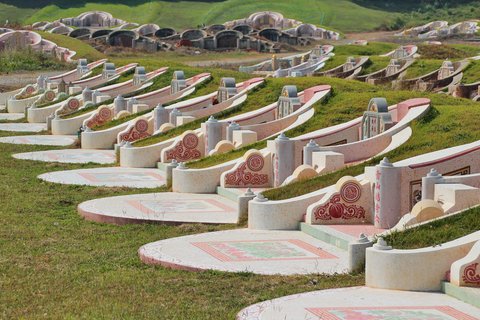
Steps for Assessing Yin House Feng Shui
1. Dragon
The Dragon refers to winding mountain ranges. The direction of the mountains twists and turns like a dragon’s body, so the ancients vividly called them “dragons”. In plains where there are no mountains, the dragon goes underground, i.e., undulating rock and soil layers. The “qi” (energy) mentioned in Feng Shui attaches to the dragon, and the direction of qi is consistent with the dragon’s vein—if the dragon’s vein is broken, the qi will also be cut off. Dragons are divided into auspicious and inauspicious: Mountain ranges that are bright, plump, round, powerful and majestic are called “true dragons”; those with broken stones, slanting shapes, bloated looks, weak momentum and no trees are called “old dragons” or “dead dragons”.
2. Cave
The ancients believed that the earth hides “vital energy” which can bring blessings to people. Vital energy flows—it disperses when exposed to wind and stops when it meets water. Site selection should focus on places where vital energy gathers, i.e., places not exposed to wind but with flowing water. Such places are called “caves”, which are the points where qi comes along the dragon and finally gathers. Caves are divided into yin and yang: Yang caves refer to residences (for the living), while yin caves refer to Yin Houses (for ancestors).
3. Sand
The mountains around the cave (front, back, left and right) are called “Sand”. Feng Shui names these sand mountains after the Four Divine Beasts: Vermilion Bird (front, south), Black Tortoise (back, north), Azure Dragon (left, east), White Tiger (right, west). A good Yin House should not only have a backing mountain behind it, but also protective sand mountains on the left and right, making the entire cave area form an embracing shape. This can resist the damage of wind to the energy field and achieve the effect of gathering qi.
4. Water
Water refers to rivers or roads. Qi flows along with water—the direction of water is the direction of qi, and the flow of water drives the flow of qi. Different water bodies gather different qi. In real life, people’s dependence on water exceeds that on mountains, as the ancients said: “Mountains govern the number of descendants, water governs wealth” and “In Feng Shui practice, obtaining water is the top priority, and hiding from wind is secondary.”
5. Direction
The last step in assessing Yin House Feng Shui is “Determining the Direction”, i.e., confirming the “sitting and facing directions” of the Yin House according to the conditions of “Dragon, Cave, Sand, Water” (the direction it faces away from is “sitting”, and the direction it faces is “facing”). This ensures that “Dragon, Cave, Sand, Water” all serve the Yin House and keep the vital energy “gathered without dispersing”. In Yin House Feng Shui assessment, “Direction” is listed last but is actually the most important element. As the ancients said: “Good or bad fortune for a thousand miles depends on the direction.” “Dragon, Cave, Sand, Water” are like building materials; when building with these materials according to the blueprint, the final result is determined by “Direction”. “Direction” plays a role in taking the lead and overseeing the overall situation. Only after determining the direction can we judge whether the dragon is a living dragon, dead dragon, prosperous dragon or exhausted dragon; whether the sand is auspicious and in the right position; and whether the water is vital water, prosperous water, declining water or tomb water… The ultimate goal of Feng Shui assessment is to find a suitable place for burial, and this place is the Cave.
Therefore, the Cave is the core of the Five Principles of Geography, and “Dragon, Sand, Water” all serve it. To find a good Cave, you must first enter the mountains to seek the Dragon: find the mountain range full of vital energy among the numerous mountains, then follow its trend to find the place where the mountain momentum stops—that is where vital energy condenses. Then check the sand and water situation around it: “sand surrounding and water embracing” means there is an auspicious Cave nearby, while “sand flying and water flowing” means there is no auspicious Cave. After finding the Cave site, place a compass in it to determine the direction… The process of assessing Yin House Feng Shui is very complex. As the saying goes: “Three years to seek the dragon, ten years to select the cave.” We do not want to simplify this process, as it will lead people astray and harm others as well as ourselves.