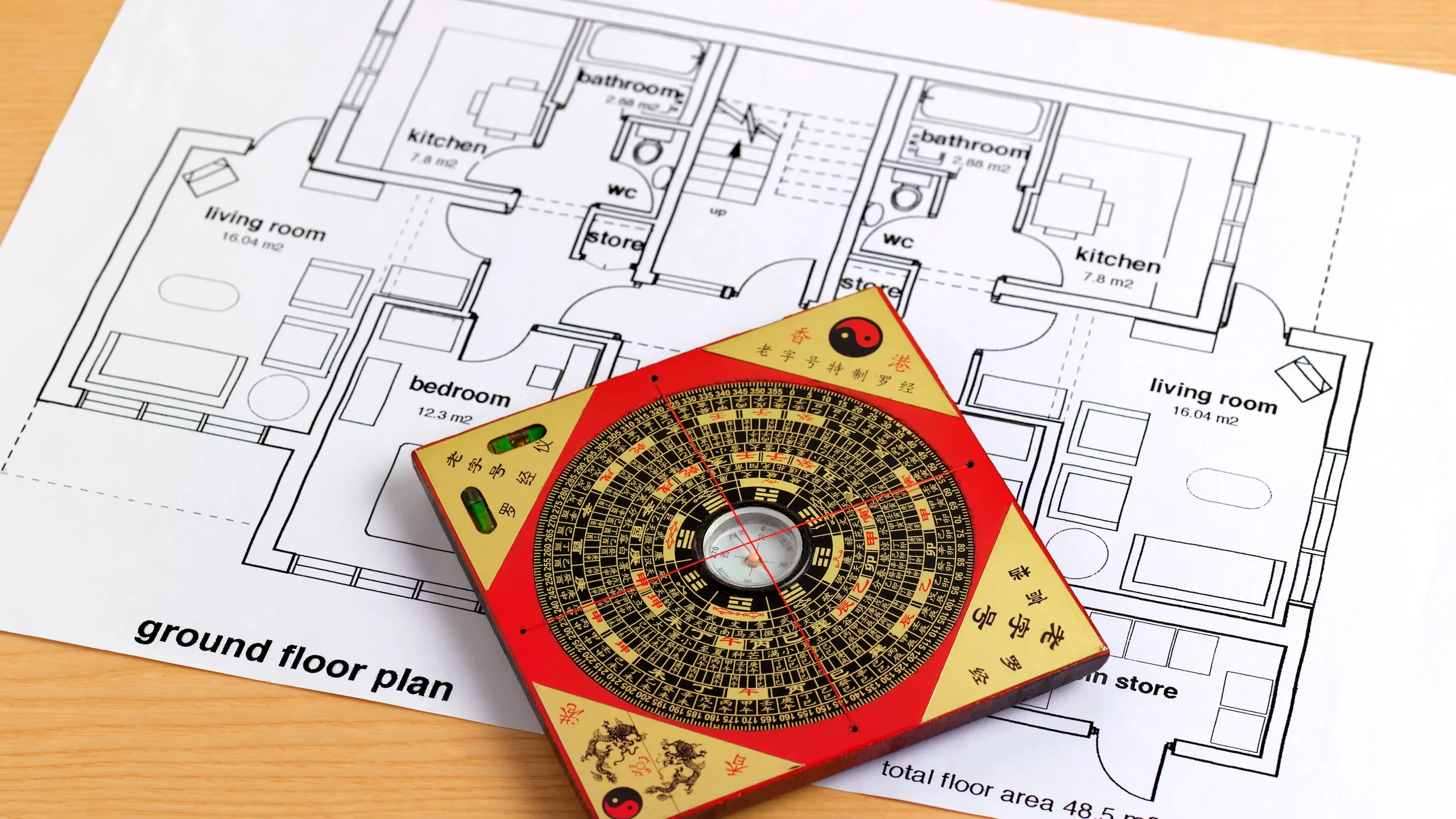
The Feng Shui compass (also known as the “Kanyu compass”) is an indispensable tool in Feng Shui, widely used to determine terrain, house orientation, and auspicious/inauspicious directions. Its design originates from the ancient Chinese philosophy of the “I Ching,” incorporating elements such as Yin and Yang, the Five Elements, the Eight Trigrams, and the Nine Palaces. It is an essential tool for Feng Shui masters when conducting Feng Shui surveys and adjusting layouts. For beginners, mastering the use of a Feng Shui compass requires time and practice, but through gradual learning, you can understand and apply its basic principles to improve the energy field of your living environment.
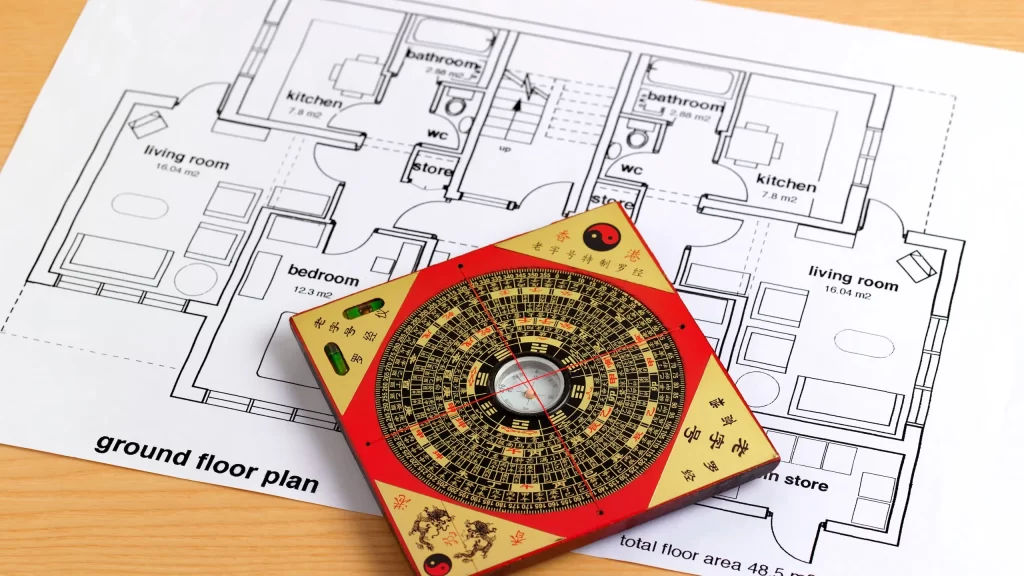
The following is a detailed explanation of how to use a Feng Shui compass
1. Basic Structure of a Feng Shui Compass
A Feng Shui compass typically consists of multiple rings, each engraved with different symbols representing different directions, the Five Elements, the Eight Trigrams, etc. The basic structure of the compass is as follows:
The outermost ring (direction ring) represents the 24 solar terms, with each solar term corresponding to a direction, similar to a compass needle.
The second circle (Heavenly Stems and Earthly Branches circle) relates to the Heavenly Stems and Earthly Branches of the I Ching, with each direction representing a different Heavenly Stem and Earthly Branch.
The third circle (Eight Trigrams circle) represents the directions of the Eight Trigrams, embodying the Eight Trigrams theory in Feng Shui.
The fourth circle (Five Elements circle) corresponds to each direction with one of the Five Elements (Metal, Wood, Water, Fire, Earth), aiding in the analysis of the energy attributes of different directions.
The central pointer (magnetic needle) points north, helping to determine the baseline for direction.
2.Basic Usage of a Feng Shui Compas
Step 1: Determine the Center Point of the House or Environment
Before using a Feng Shui compass, you first need to determine the center point of the house or environment you want to analyze. This center point is usually the geometric center of the building, or the center of the area you want to analyze.
Step 2: Find Magnetic North with the Compass
The Feng Shui compass has a magnetic needle in the center, pointing to magnetic north (geographic North and magnetic North have slight deviations). When using the compass, you first need to ensure the magnetic needle points north. The direction indicated by the magnetic needle is the baseline direction for direction analysis.
Step 3: Align the Compass with the Base Point
Place the compass in the center of the house or location to be analyzed, ensuring it is stable and level. Keep the compass still so the magnetic needle points north. Then, ensure that the “north” on the compass matches the actual geographical north (usually verifiable using a mobile phone compass or other tools).
Step 4: Observe the Directional Markings on the Compass
A compass typically has 360 degrees, representing different directions. The 24 directions form the basis of a Feng Shui compass, each corresponding to approximately 15 degrees. For example:
North (0°) Magnetic North
East (90°) East
South (180°) South
West (270°) West. The Feng Shui compass uses these directions to analyze the influence of Qi (energy) and terrain. You can use these directions to determine if the house layout is suitable and whether it has auspicious or inauspicious effects.
Step 5: Analyze the Five Elements Attributes of the Directions
Based on the five-element circle on the compass, you can analyze the five-element attributes represented by each direction. For example:
North (0°) Water
East (90°) Wood
South (180°) Fire
West (270°) Metal
Center (Central Palace) Earth. By analyzing these attributes, you can determine whether the five elements are balanced in different directions of the house. For example, if the five elements in a certain direction are too strong, it may lead to an unfavorable energy field, which needs to be adjusted through feng shui arrangement.
Step 6: Analysis of the Eight Trigrams and Heavenly Stems and Earthly Branches
The feng shui compass has eight trigrams, each representing different natural phenomena and energies. For example, Qian represents Heaven, Kun represents Earth, Zhen represents Thunder, Xun represents Wind, etc. By analyzing the relationship between the eight trigrams in the house’s directions, you can understand whether the house’s energy field is harmonious.
The feng shui compass also marks the Heavenly Stems and Earthly Branches, which is very helpful for deeper astrological analysis. The five elements and eight trigrams of the Heavenly Stems and Earthly Branches are interconnected, and they can be used to analyze the energy flow and changes in a certain direction. Step 7: Arrange the Layout According to Feng Shui Principles
Based on the compass analysis, the Feng Shui master will provide corresponding Feng Shui adjustment suggestions. For example:
Main Door Facing Negative Energy: If the main door faces negative energy (such as a sharp corner or straight road), it may lead to bad luck. In this case, the Feng Shui compass can be used to determine the direction and take appropriate measures to mitigate the negative effects.
Wealth Position Adjustment: Based on the Five Elements analysis of the compass, determine the wealth position in the home (usually the location with the strongest and most auspicious energy flow). Then, adjust household items according to this position, such as placing wealth-attracting items or adjusting seating arrangements.
3. Precautions for Using a Feng Shui Compass
Keep the Compass Level: When using a compass, ensure it is placed stably and avoid tilting. Tilt will prevent the magnetic needle from accurately pointing north, thus affecting the direction determination.
Avoid Interference from Surrounding Magnetic Fields: The magnetic needle of the compass is affected by surrounding magnetic fields. Therefore, avoid placing it near electrical appliances, large metal objects, or other strong magnetic field sources. These interferences will affect the accuracy of the compass.
Precision Practice: The use of a Feng Shui compass demands high precision, especially in large buildings or complex terrains where meticulous adjustments and analysis are often required. Beginners can start with simple house layout analysis and gradually improve their skills.
Theoretical Practice: Theoretical knowledge and practical experience are equally important when using a Feng Shui compass. While the compass provides basic data on direction and the Five Elements, determining whether an environment has “good Feng Shui” requires considering factors such as terrain, building structure, and airflow. Therefore, learning and practice must be combined to gradually accumulate experience.
Advanced Usage: After mastering the basic usage, you can further study advanced uses of the Feng Shui compass. As your knowledge of Feng Shui deepens, you will be able to conduct more complex technical analyses using the compass, such as:
Combining Yin and Yang with the Eight Trigrams and the Five Elements theory to analyze the influence of various directions on different individuals or family members.
Using astrological Feng Shui: Based on an individual’s birth chart (Ba Zi), the Feng Shui compass helps select the most suitable living environment and direction.
Using dynamic Feng Shui: Analyzing changes in the environmental energy field using the Feng Shui compass to determine the best time for adjustments. 5. Advanced Learning Resources
To further refine your compass skills, you can learn through the following methods
Books: Some classic Feng Shui books will detail the techniques and practical examples of using the Feng Shui compass, helping you better understand its working principles.
Online Courses: Many Feng Shui masters and institutions now offer systematic online courses specifically designed to teach how to use the Feng Shui compass, using real-world examples.
Practice: Only through practice, continuously using the Feng Shui compass in different environments, can you accumulate experience and master various Feng Shui analysis methods.
Summary: The Feng Shui compass is a very important tool in Feng Shui, helping you accurately analyze the Qi (energy) field, orientation, and energy flow of environments such as houses and offices. Mastering the use of the Feng Shui compass requires systematic learning of theoretical knowledge and practical operation to gradually improve your skills. Learning the Feng Shui compass is not just about mastering a tool, but also a process of understanding and applying the principles of Feng Shui.